Skip to content ↓

News and Letters

Page 3

  • Zones of Regulation Parent Workshop

    Published 09/12/23

    Miss Morris and Mrs Topham gave two excellent workshops, introducing our new approach to behaviour management, focusing on the Zones of Regulation.

    Why Teach Self-Regulation?

    Regulation is something everyone continually works on whether we are aware of it or not. We all encounter trying circumstances that can test our limits. If we can recognise when we are becoming less regulated, we are able to do something about it to manage our feelings and get ourselves to a healthy place. This comes more naturally for some, but for others it is a skill that needs more attention and practice. This is the goal of The Zones of Regulation​.

    Sorting Our Emotions Into Four Zones

    Feelings are complicated. They come in different sizes, intensities, and levels of energy that are unique within our brains and bodies. To make them easier to talk about, think about, and regulate, The Zones of Regulation organizes our feelings, states of alertness, and energy levels into four colored Zones – Blue, Green, Yellow, and Red. The simple, common language and visual structure of The Zones of Regulation helps make the complex skill of regulation more concrete for learners and those who support them. We learn to regulate our Zones to meet our goals and task demands, as well as support our overall well-being.

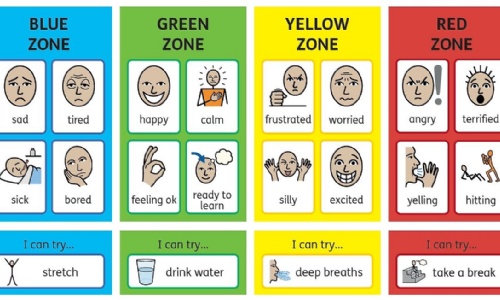
    The BLUE ZONE describes low states of alertness and down feelings, such as when a person feels sad, tired, sick, hurt, lonely, or bored. Our energy is low and our body is moving slowly when we are in the Blue Zone.

    When in the Blue Zone we often need to rest and recharge to meet our goals. We can regulate by seeking (or co-regulate by offering) comfort, energizing, or resting. If we are feeling sick in the Blue Zone, we may need to rest. If we are feeling tired, we may need to energize (depending on the context). If we are feeling sad, we may need comfort. In all these situations, the common theme is noticing our lower energy and/or down feelings and options for managing them.

    The GREEN ZONE describes a calm, alert state. We may be feeling happy, focused, content, peaceful, or calm in the Green Zone. The nervous system feels safe, organized, and connected in the Green Zone, helping us be primed to learn. However, we can learn in other Zones too.

    When in the Green Zone we regulate by using tools and supports that keep us moving forward comfortably, helping us feel ready to go! In the Green Zone, we might regulate by choosing to eat a healthy snack, exercise, take a break, or pause for a mindful moment. These restorative actions help us proactively care for ourselves so we can move forward with ease.

    The YELLOW ZONE describes when our energy is higher, and our internal state starts to elevate. Our emotions get a little stronger. We may be experiencing stress, frustration, anxiety, excitement, silliness, confusion, nervousness, be overwhelmed, or have the wiggles, when in the Yellow Zone.

    In the Yellow Zone we may need to take action to regulate to manage our energy and feelings as they get stronger. For example, if we are feeling energetic at the lunch table it helps to use caution and take a deep breath, so we do not spill something. If we are feeling nervous before our performance, we can slow down our racing thoughts and speech by using a mindfulness tool. When we are frustrated, and pause to take notice, we can decide to take a break to collect ourselves before we say something we regret.

    The RED ZONE describes a state of extremely high energy and intense, very overwhelming feelings. We may be in an extremely heightened state of alertness, potentially triggering our fight, flight, freeze or flee protective response. We may feel elated, euphoric, angry, rage, devastated, out of control, panicked, or terrified when in the Red Zone.

    When in the Red Zone we might need to pause and assess if we need to regulate and gain a sense of control of our strong feelings and high energy. For example, if we are feeling angry, it may help to pause and count to 10 before we act. If we are panicked, we can stop and use our self-talk to help us gain a sense of control of our thoughts in order to meet our goal. If we are elated, such as when a teammate scores the winning point, we might need to pause and take a big breath to regulate our impulse to run out on the field to celebrate if there is still time on the clock.

    All the Zones are Okay

    A core belief of The Zones of Regulation is that all the Zones are okay. We routinely experience several of the Zones within a day. It’s critically important that we don’t convey the message that the Green Zone is the only acceptable Zone to be in. Acknowledge, accept, and support these feelings, never make anyone feel like the Green Zone is the norm.


    Please find below their presentation, plus additional useful information for families. 

    Read More
  • New Islington News - Edition 11

    Published 08/12/23

    Attendance information

    Reception- 92.07% - well done - improved from last week

    Year 1- 92.35%

    Year 2- 94.25%

    Year 3- 93.96%

    Year 4 - 97.48% - well done - improved from last week

    Year 5- 89.43%

    Year 6- 94.61%- well done - improved from last week 

    Best attendance this week is 4EB Winner- 98.72%


    General notices

    Miss Morris is getting married on 16th December! We wish her much happiness and joy on her special day, and going forward. She will change her name to Mrs Holt. If you see Miss Morris next week, pop in to give her congratulations! 


    We say our fond farewells to Madame Flo. Madame Flo knows all our pupils from Reception through to Year 6 because of the part that she plays in our Forest School sessions. Madame Flo is always so kind, patient and encouraging. The children adore their forest school sessions because of the calm magic she brings. We will all miss her greatly and thank her for her dedication and hard work (in rain and shine) to ensure all our pupils gain so much from their time outside.  


    The Co-op Academies Trust have provided every pupil in all of their schools with a Christmas Selection box. Our thanks go to the Central team who organised 19,500 boxes to be delivered to all 32 schools.


    Toys and games: Please can parents check their child’s school bag and pockets for toys, games, trinkets, notebooks, handbags with little bits and bobs inside etc. These cause issues in the classroom and playground, cause friendship problems, anxiety and take attention away from teaching and learning. Thank you for your support. 


    Events and key dates

    Monday 11th November: Parent Forum at 2:30. Come along with questions and queries, as well as things you feel are going well. 

    Tuesday 12th December: Reception Christmas carol concert. Families are most welcome. Please arrive in time for a 9:30 start. 

    Wednesday 13th December: Key Stage One Carols and Readings. Families are most welcome. Please arrive in time for a 9:15 start.

    Wednesday 13th December: Christmas Jumper Day - if your child has a festive jumper, they can wear it today. 

    Wednesday 13th December: Christmas Dinner Day. We will provide a roast dinner for all of our pupils; no need to bring a packed lunch today.

    Wednesday 13th December: Parties for Reception, Years 1,2, 4 & 5. (Party clothes / Christmas Jumper) 

    Thursday 14th December: Music Concert. Parents of those performing are most welcome to attend. Please arrive in time for a 9:30 start. 

    Friday 15th December: Parties for Year 3&6 (home clothes / party clothes)

    Friday 15th December: Last day of term.

    Wednesday 3rd January: School starts for all pupils.

    Monday 8th January: History/Drama Workshop for Year 2 pupils - Great Fire of London. Please pay via Arbor

    Thursday 11th January: History/Drama Workshop for Year 4 pupils - The Romans. Please pay via Arbor

    Monday 15th and Tuesday 16th January: Screening for Reception pupils. 

    Tuesday 27th February: Year 3 FC to Manchester Museum. More details and payment options nearer the time. 

    Thursday 29th February: Year 3 IPLR to Manchester Museum. More details and payment options nearer the time.  


    Forest school

    Monday 11th December Year 4 Miss Ballentine

    Friday 15th December Year 5 Mrs Lawson

    Reception - alternate Fridays; please refer to the notices in classroom windows. 


    Read More
  • New Islington News - Edition 10

    Published 01/12/23

    Attendance: We continue to monitor the number of pupils who arrive late. We have posted out invitations to an attendance meeting on Monday 11th December to our families who are persistently late.  

    Whole school- 94.06%

    Reception- 87.88% 

    Year 1- 93.33%

    Year 2- 95.0% Well done - improved from last week

    Year 3- 97.05% Well done - improved from last week

    Year 4 - 97.15% 

    Year 5- 94.3% F

    Year 6- 94.44% 

    Best attendance this week is 3IP/LR at 99.11%

    General notices

    Elfridges: Elfridges is a wonderful way for your children to choose, wrap and give a secret present for their mum, dad or grandparents. Last day to buy your tickets is today! 

    Behaviour and Zones of Regulation Presentation: Following on from the parent workshop focussing on our behaviour policy and Zones of Regulation, held at 9am on Thursday 30th November, we are offering a virtual session on Monday 4th December at 5pm. 

    Please join the Monday virtual session using this link:

    Online (Virtual) parent workshop - behaviour policy and Zones of Regulation

    Monday, 4 December · 5:00 – 6:00pm

    Time zone: Europe/London

    Google Meet joining info

    Video call link: https://meet.google.com/qkg-bsop-xuv

    Or dial: ‪(GB) +44 20 3956 0231‬ PIN: ‪980 913 812‬#

    More phone numbers: https://tel.meet/qkg-bsop-xuv?pin=7690974030446


    Party invitations: Please can we politely request that parents hand out invitations / cards to parents discretely before or after school. Please do not hand it directly to the child. If you work full time and are never at school, please pass the invitations on to a friend to hand out. Please do not send invitations in with your child and ask them to hand them out, or ask our staff to do this for them. Many thanks for your cooperation. 

    Toys and games: Please can parents check their child’s school bag and pockets for toys, games, trinkets, notebooks, handbags with little bits and bobs inside etc. These cause issues in the classroom and playground, cause friendship problems, anxiety and take attention away from teaching and learning. Thank you for your support. 

    Events and key dates

    Monday 4th December: An online version of the Behaviour / Zones of Regulation meeting 5pm. Joining details as above.

    Tuesday 5th and Thursday 7th December: Parents evening for Year 6LB and Year 5CL. Book your appointment online via Arbor.

    Thursday 7th November: Choir to perform at New Islington Medical Practice

    Thursday 7th November: Elves come to school for the Elfridges event. 

    Monday 11th November: Parent Forum at 2:30. Come along with questions and queries, as well as things you feel are going well. 

    Tuesday 12th December: Reception Christmas Carol Concert. Families are most welcome. Please arrive in time for a 9:30 start. 

    Wednesday 13th December: Key Stage One Carols and Readings. Families are most welcome. Please arrive in time for a 9:15 start.

    Wednesday 13th December: Christmas Jumper Day - if your child has a festive jumper, they can wear it today. 

    Wednesday 13th December: Christmas Dinner Day. We will provide a roast dinner for all of our pupils; no need to bring a packed lunch today.

    Wednesday 13th December: Parties for Reception, Years 1,4 & 5. (Party clothes / Christmas Jumper) 

    Thursday 14th December: Music Concert. Parents of those performing are most welcome to attend. Please arrive in time for a 9:30 start. 

    Friday 15th December: Parties for Year 3&6 (home clothes / party clothes)

    Friday 15th December: Last day of term.

    Wednesday 3rd January: School start for all pupils.

    Monday 8th January: History/Drama Workshop for Year 2 pupils - Great Fire of London. Please pay via Arbor

    Thursday 11th January: History/Drama Workshop for Year 4 pupils - The Romans. Please pay via Arbor

    Monday 15th and Tuesday 16th January: Screening for Reception pupils. 

    Tuesday 27th February: Year 3 FC to Manchester Museum. More details and payment options nearer the time. 

    Thursday 29th February: Year 3 IPLR to Manchester Museum. More details and payment options nearer the time.  


    Forest school

    Monday 4th December Year 4 Miss Morris

    Friday 8th December Year 2 Mr Jackson

    Monday 11th December Year 4 Miss Ballentine

    Friday 15th December Year 5 Mrs Lawson

    Reception - alternate Fridays; please refer to the notices in classroom windows.

    Read More
  • New Islington News -Edition 9

    Published 24/11/23
    You said - we have listened   We will simplify how we communicate with you.  Our Reception parents will have all forms of written communication sent via Tapestry.  Our families in Year 1 through to Year 6 will ha
    Read More
  • Do you or your child struggle to sleep?

    Published 21/11/23

    At any given time, up to 40% of adults and 50% of children (this rises to 80% with a SEND diagnosis) have difficulties with their sleep. Yet in a recent survey, almost 60% of adults felt there was a lack of support for sleep issues. Sleep problems can leave people feeling isolated and lonely.


    The Sleep Charity offers a free helpline that is run by trained sleep advisors, many of whom are specialists in working with SEND. We can talk to young people directly, or parents (we can also talk to adults, including older people, about their sleep issues).


    The helpline is open 5 times a week; Monday, Tuesday, Thursday evenings 7-9pm, and Monday, Wednesday mornings, 9-11am. The number is 03303 530 541.


    You can read more here: https://thesleepcharity.org.uk/national-sleep-helpline/

    Read More
  • Elfridges returns to New Islington!

    Published 21/11/23

    Buy your tickets now!

    Read More
  • New Islington News - Edition 8

    Published 17/11/23

    Attendance for this week - we are doing great!

    Overall: 95.87% (up on last week - second week in a row with improved attendance)

    Year 6: 95.28% (up on last week - improvements second week in a row. Fantastic!)

    Year 5: 95.03% (up on last week - keep this going!)

    Year 4: 97.125% (up on last week - improvements second week in a row. Fantastic!)

    Year 3: 95.24% (up on last week - keep this going!)

    Year 2: 95.25% (up on last week - keep this going!)

    Year 1: 95.25% (in line with last week)

    EYFS: 97.01% (up on last week - improvements second week in a row. Fantastic!)

    The overall winner this week is Rec NE with an overall attendance of 97.53%. 

    Late arrivals: Over the last 5 mornings, we have had 69 pupils arriving after the start of lessons. Let's work together to reduce this rapidly. 

    Coming up: Please refer to the school calendar and the News and Letters section of our website

    https://www.newislington.coopacademies.co.uk/calendar/?calid=1&pid=7&viewid=1

    https://www.newislington.coopacademies.co.uk/stories

    20th: Health screening for EYFS and Year 6

    21st: Year 4 Chocolatier experience - please pop onto Arbor to pay

    23rd: Year 5&6 road safety drama / after school bike checks

    https://www.newislington.coopacademies.co.uk/news/?pid=59&nid=2&storyid=137

    30th: Parent workshop on our behaviour approaches and Zones of Regulation

    https://www.newislington.coopacademies.co.uk/news/?pid=59&nid=2&storyid=142

    Check out our new galleries: 

    https://www.newislington.coopacademies.co.uk/gallery/?pid=59&gcatid=1

    Advance notice: ELFRIDGES IS RETURNING TO NEW ISLINGTON......look out for information coming your way! 


    Read More
  • Could you be our Community Pioneer?

    Published 17/11/23

    Do you want to make a difference to people living in your community? 

    Read More
  • New Islington News - Edition 7

    Published 09/11/23

    Attendance: As always, we track our attendance and the number of pupils who arrive late. Every minute and every day counts; progress and academic outcomes are affected by poor attendance.

    Please see more information about the importance of regular attendance here:

    https://www.newislington.coopacademies.co.uk/news/?pid=59&nid=2&storyid=141 

    This week our attendance at our school has been:

    Overall: 95.7% (up on last week)

    Year 6: 94.82% (up on last week - well done, keep this going!)

    Year 5: 94.99% (down on last week)

    Year 4: 97.12% (up on last week - well done, keep this going!)

    Year 3: 95.02% (down on last week)

    Year 2: 94.73% (down on last week)

    Year 1: 95.95% (up on last week - well done, keep this going!)

    EYFS: 97.04% (up on last week - well done, keep this going!)

    The overall winner this week is Year 4JM with an overall attendance of 97.53%. 

    Lateness: We have a real focus on the number of pupils who arrive late; too many children arrive at school after 9am. 

    All children need to arrive at school by 8:45, so they are waiting at the classroom doors to come in at 8:50. Anyone not sitting down in class at 9am is marked as being late. We track the number of minutes late each day. This quickly adds up. Some pupils are so late that they get an Unauthorised Absence register code which could result in a penalty notice being issued.  

    Competition time: We ran a competition to celebrate Black History Month. Check out the amazing entries; please admire the beautiful entry from our Year 2 pupil, Elissa. Congratulations, Elissa! 

    https://www.coopacademies.co.uk/saluting-our-sisters-this-black-history-month

    Anti-bullying week: Through our teaching and our assemblies, we will be shining a spotlight on the negative effects of bullying. Please read more here:

    https://www.newislington.coopacademies.co.uk/news/?pid=59&nid=2&storyid=143

    Children in Need: On Friday 17th November, pupils can come to school dressed in yellow, wearing spots, or odd-socks. Please read more here:

    https://www.newislington.coopacademies.co.uk/news/?pid=59&nid=2&storyid=144

    Read More
  • Children in Need Friday 17th November 2023

    Published 07/11/23

    Come to school on Friday 17th November wearing something spotty, or something yellow! 

    Don't forget, to show we stand up to bullying, you could also wear odd socks!

    A donation of £1:00 would be appreciated. 


    Read More
  • Anti-bullying Week November 13th - 17th 2023

    Published 07/11/23

    Anti-bullying Week: Monday 13th to Friday 17th November 2023

    Come to school on Friday 17th November wearing odd-socks, to show that we stand together against bullying! 


    Read More
  • Zones of Regulation

    Published 03/11/23

    Zones of Regulation 


    We are very excited to be launching ‘Zones of Regulation’ across the school from November 2023.  We hope that this will help our children to learn how to recognise and manage their difficult emotions in a safe way. 

    What is ‘Zones of Regulation’ Intervention?   


    Zones of Regulation is an internationally-renowned intervention which helps children to manage difficult emotions, known as ‘self-regulation’. Self-regulation can go by many names such as ‘self-control’, ‘impulse management’ and ‘self management’.  Self-regulation is best described as the best state of alertness for a situation.  For example, when your child takes part in a sports game, they would need to have a higher state of alertness than when, for example, they were working in a library. From time to time, all of us (including adults) find it hard to manage strong feelings such as worry, anger, restlessness, fear or tiredness, and this stops us from getting on with our day effectively. 


    Children who feel these emotions often find it hard to learn and concentrate in school.  Zones of Regulation aims to teach children strategies to help them cope with these feelings so they can get back to feeling calm and ready to learn. These coping strategies are called ‘self-regulation’. At Co-op academy New Islington, we are launching Zones of Regulation throughout the whole school.  We want to teach all of our children good coping and regulation strategies so they can help themselves when they experience anxiety and stress. 


    In the classroom, sometimes children panic when faced with a tricky learning problem or challenge. By teaching them how to recognise, validate and cope with these feelings, we might make them better at tackling learning challenges and build better resilience so they don’t give up so easily when faced with difficulty.  We want our children to grow into successful teenagers, then adults.  Teaching the children at a young age about managing their feelings will support them in later life so that they don’t turn to negative coping strategies which affect their mental and physical wellbeing.  

    We aim to help children to: 


    • Recognise when they are in the different Zones and learn how to change or stay in the Zone they are in. 

    • Increase their emotional vocabulary so they can explain how they are feeling.

    • Recognise when other people are in different Zones, thus developing better empathy. 

    • Develop an insight into what might make them move into the different Zones.

    • Understand that emotions, sensory experiences such as lack of sleep or hunger and their environment might influence which Zone they are in. 

    • Develop problem-solving skills and resilience 

    • Identify a range of calming and alerting strategies that support them (known as their personal ‘toolkit’.)  


    What are the different Zones? 


    Blue Zone: low level of arousal; not ready to learn; sad, sick, tired, bored, moving slowly. 


    Green Zone: calm state of alertness; optimal level to learn; happy, calm, feeling okay, focused. 


    Yellow Zone: heightened state of alertness; elevated emotions; some control; frustrated, worried, silly/wiggly, excited, loss of some control. 


    Red Zone: heightened state of alertness and intense emotions; not an optimal level for learning; out of control; mad/angry, terrified, yelling/hitting, elated, out of control.    


    We will teach the children that everyone experiences all of the Zones, and validate their feelings. The Red and Yellow Zones are not ‘bad’ or ‘naughty’ Zones. All of the Zones are expected at one time or another.  We will show them that the Blue Zone, for example, is helpful when you are trying to fall asleep. 


    How will my child learn about Zones of Regulation?


    We will be introducing the Zones through discrete teaching lessons and through our PSHE curriculum.  We will also be using the Zones language as part of daily school life so all staff will be referring to them, not just their class teacher. Some children might prefer not to use the ‘Zones language’ but label the emotions directly – this is fine and encouraged! Each classroom will have a Zones display and children will be encouraged to use this display interactively. They will check in twice a day during register time, using the Zones as a way of identifying and communicating how they feel. 

    How can you help your child use The Zones of Regulation at home? 


    • Identify your own feelings using Zones language in front of your child (e.g.: I’m frustrated. I think I am in the Yellow Zone.”) 

    • Talk about what tool you will use to be in the appropriate Zone (e.g.: “I need to take four deep breaths to help get me back to the Green Zone.”) 

    • At times, wonder which Zone your child is in. Or, discuss which Zone a character in a film / book might be in. (e.g.: “You look sleepy. Are you in the Blue Zone?”)

    • Engaging your child in discussion around Zones when they are in the Red Zone is unlikely to be effective. You need to be discussing the different Zones and tools they can use when they are more regulated / calm. Teach your child which tools they can use. (eg: “It’s time for bed. Let’s read a book together in the comfy chair to get you in the Blue Zone.”) 

    • Regular Check-ins. “How are you feeling now?”  and “How can you get back to Green?” It is important to remember to show the children how you use tools to get back to the green zones. You might say “I am going to make myself a cup of tea and do some breathing exercises because I am in the blue zone” and afterwards tell your child how using those tools helped you get back to the green zone. 

    • Share how their behaviour is affecting your Zone. For example, if they are in the Green Zone, you could comment that their behaviour is also helping you feel happy / go into the Green Zone. 

    • Put up and reference the Zones visuals and tools in your home. Praise and encourage your child when they share which Zone they are in.    


    Tips for practising Zones of Regulation 


    • Know yourself and how you react in difficult situations before dealing with your child’s behaviours. 

    • Know your child’s sensory threshold. We all process sensory information differently and it impacts our reactivity to situations. 

    • Know your child’s triggers. 

    • Be consistent in managing your child’s behaviour and use the same language you use at home. 

    • Empathise with your child and validate what they are feeling. 

    • Have clear boundaries/routines and always follow through. 

    • Do not deal with an angry, upset child when you are not yet calm yourself. 

    • Discuss strategies for the next time when you are in a similar situation. 

    • Remember to ask your child how their choices made you feel (empathy). 

    • Praise your child for using strategies. 

    • Encourage your child to take a sensory break to help regulate their bodies. 

    • Create a ‘calm’ box full of things which help to keep your child calm and alert. 


    Read More

Page 3